GPT-5.5 and the Rise of AI Super Apps
Explore GPT-5.5's architecture, features, use cases, and AI super app potential. Learn how it improves reasoning, coding, automation, and workflows.
8/2/2026
GPT-5.5 and the Rise of AI Super Apps
artificial intelligence
9 min read

GPT-5.5 and the Rise of AI Super Apps
GPT-5.5 emerges as a major step in AI innovations, as it combines improved reasoning, specialization, and multimodal capabilities. This model is specially positioned for general intelligence and task-specific systems, which helps the model to interact with tools and users. With our blog, we will help you explore its architecture, some core upgrades, use cases, and its ability to shape AI super apps.
What is GPT-5.5?
GPT 5.5 is an advanced AI model that introduces improved reasoning, efficiency, and task specialization compared to models available previously. It exhibits uplifted multimodal understanding, tool use, and contextual handling, eventually helping it to contribute more accurate, quicker, and adaptive responses for different applications and workflow needs.
How is GPT-5.5 different from GPT-5.4?
GPT-5.5 is developed upon the foundation led by GPT-5.4; it prioritises focusing on greater autonomy, stronger coding performance, enhanced tool orchestration, and more dependable long-horizon task execution. As both models share a 1M-token context window, GPT-5.5 is particularly developed to complete extremely complex workflows with minimal user interruption for realigning it. 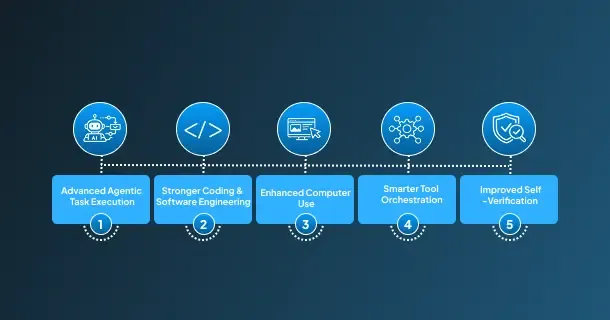
Aspect | GPT-5.4 | GPT-5.5 |
Primary Goal | Unified reasoning, coding, and tool use | More autonomous execution and agentic workflows |
Context Window | 1M tokens | 1M tokens |
SWE-Bench Pro (Coding) | 57.7% | 58.6% (+0.9 points) |
GDPval (Knowledge Work) | 83% | Improved over GPT-5.4 (OpenAI did not publish a specific score) |
Computer Use | Native computer-use capabilities | More reliable software and workflow execution |
Agentic Behavior | Requires more user guidance | Better planning and task completion with less supervision |
Coding | Strong frontier coding | Improved coding, debugging, and large codebase understanding |
Tool Use | Advanced tool calling | Better tool orchestration and autonomous tool selection |
User Supervision | More prompt guidance required | Less user intervention required |
Efficiency | Major token-efficiency gains vs GPT-5.2 | Further efficiency improvements while increasing performance |
Research | Strong analysis and knowledge work | Better scientific reasoning and multi-source synthesis |
What is the architecture behind GPT-5.5 and why is it specialized?
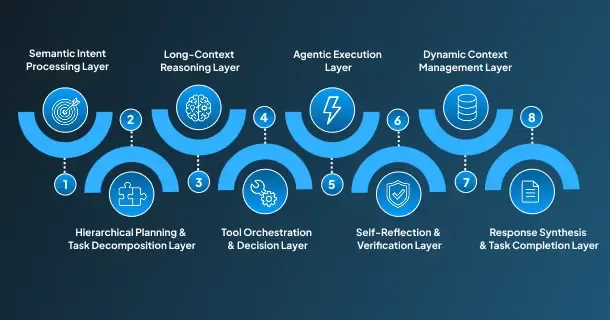
Although no exact neural architecture for GPT 5.5 has been publicly revealed, the model can be understood as a layered agentic AI system specifically built to autonomously plan, reason, execute, verify, and complete complex tasks. One way to conceptualize GPT-5.5 is as a system that appears to coordinate reasoning, context handling, tool use, and response generation to transform user intent into useful outcomes.
1. Semantic Intent Processing Layer
The first layer functions to interpret user instructions and find out the objectives, constraints, and priorities, and specify the desired outcomes. Instead of processing prompts exactly, it extracts the in-depth intent and eventually converts natural language requests into structured goals for downstream reasoning systems.
2. Hierarchical Planning & Task Decomposition Layer
The next layer here is working to understand the underlying goal to help GPT-5.5 generate a strategy. This happens by breaking complex requests into smaller subtasks, which makes dependencies, and prioritizing actions to implement a more efficient roadmap for task execution.
3. Long-Context Reasoning Layer
Under the long context reasoning layer, it executes multi-step reasoning across large information sets alongside maintaining consistency. This uses 1-million-token context windows to track dependencies, connect evidence, and protect coherence across the extended workflows.
4. Tool Orchestration & Decision Layer
Then there is a tool orchestration or decision layer that allows GPT-5.5 to evaluate whether external capabilities are needed to solve a task. Through this, it intelligently selects and coordinates tools such as web search, coding environments, computer-use systems, and document-processing resources.
5. Agentic Execution Layer
This execution layer converts plans into actions. Under this, it executes coding, research, software interaction, data analysis, workflow automation, and content generation while actively progressing toward the user's intended objective.
6. Self-Reflection & Verification Layer
Before generating the final output, this GPT-5.5 analyzes its outputs for accuracy and consistency. By doing this, it validates assumptions, recognizes errors, executes iterative corrections, and fine-tunes the responses to improve reliability and quality.
7. Dynamic Context Management Layer
The dynamic context management layer assists in managing relevant information throughout the task execution process. This works by prioritizing the crucial context, retrieving necessary knowledge, compressing repeated details, and maintaining continuity across long-running interactions.
8. Response Synthesis & Task Completion Layer
The final layer functions to consolidate insights, intermediate results, and verified outputs into one coherent generated output. This output could either be producing a code, research, reports, or analyses, which aligns with the initially defined end goal.
What new features does GPT-5.5 introduce?
GPT-5.5 introduces some of the really interesting capabilities that make it a helpful assistant for various complex workflows. We have listed a few significant advanced features that GPT-5.5 exhibits for executing the required tasks:
1. Advanced Agentic Task Execution
This GPT-5.5 model holds an advanced ability to independently plan, execute, and complete complex multi-step workflows with less need for user instructions. This makes it more capable of functioning as an autonomous AI agent.
2. Stronger Coding & Software Engineering
According to the report released by OpenAI, this GPT-5.5 shows significantly enhanced improvements in coding, debugging, code refactoring, large codebase understanding, and evaluation with Terminal-Bench 2.0 performance increasing from 75.1% to 82.7%.
3. Enhanced Computer Use
GPT-5.5 also exhibits enhanced performance at interacting with software applications. This performs smoother interface navigation to complete end-to-end tasks across digital environments rather than simply providing instructions for the provided input.
4. Smarter Tool Orchestration
One more amazing advancement about the GPT-5.5 model is that it can more effectively select, coordinate, and add tools such as web search, code execution, document analysis, and data processing to execute complex-natured objectives.
5. Improved Self-Verification
But the highlight about GPT-5.5 is that it introduces stronger self-checking mechanisms that validate assumptions, find errors, and refine outputs before delivery, improving overall accuracy and reliability across the generated outputs.
Who is GPT-5.5 most useful for and what are its use cases, especially for building an AI super App?
GPT-5.5 contributes amazing performance for organizations and professionals looking to build AI super apps, platforms that extend a perfect combination of multiple tools, workflows, and services into one single AI-powered experience. With its enhanced ability to reason, plan, use tools, and implement tasks intelligently, it provides a much stronger foundation for future applications.
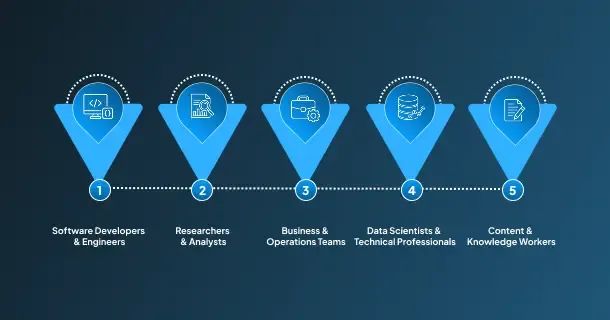
1. Software Developers & Engineers
GPT-5.5 eases developers' burden by allowing them to build an AI super app that combines a coding assistant with workflow automation, customer support, document management, and productivity tools into a single platform. With its agentic coding abilities, this not only accelerates development but also reduces engineering complexity.
Example: AI Developers Hub - combines coding, debugging, deployment, documentation, and team collaboration in one workspace.
2. Researchers & Analysts
GPT-5.5 can also be very helpful for researchers and analysts. This can be utilized for the creation of research-focused super apps that combine information retrieval, knowledge synthesis, document analysis, and reporting. This would help researchers in conducting more in-depth research by analyzing findings and generating insights without switching between multiple applications.
Example: AI Research Center – Unifies search, document analysis, summarization, and report generation.
3. Business & Operations Teams
Enterprises or businesses can build operational AI super apps that could work as a centralized reporting, workflow automation, project management, communication, and decision support platform. Eventually, this GPT-5.5 model automates routine processes while providing a single and easy-to-use interface for business operations.
Example: AI Operations Center – Connects CRM, project management, reporting, and communication tools in one platform.
4. Data Scientists & Technical Professionals
Since the future is all about using data intelligently for your tasks, with GPT-5.5, you can build AI super apps that perform data analysis, visualization, model evaluation, documentation, and reporting all under the same app. This allows teams to consolidate analytical workflows into one intelligent environment and strategize or plan accordingly.
Example: AI Data Workspace – Integrates databases, analytics, visualization, and reporting capabilities.
5. Content & Knowledge Workers
For content and knowledge management use cases, GPT 5.5 is emerging as a reliable assistant. It powers AI super Apps that can ideate, research, edit, and allow collaboration for the entire content creation pipeline from a single platform.
Example: AI Content Studio – Combines research, content creation, editing, publishing, and performance tracking.
What are the benefits and limitations of GPT-5.5 for building an AI super app?
GPT-5.5 holds immense potential for powering AI super apps for various complex workflows. This has introduced substantial enhancements in autonomy, reasoning, coding, and workflow execution, making it more capable of handling complex professional tasks. But despite all these improvements, it still holds practical hurdles that organizations and users should understand before planning a deployment of it.
Benefits | Limitations |
Greater Task Autonomy - Enables super apps to automate multi-step workflows with minimal user intervention. | Hallucinations – May occasionally generate inaccurate outputs that require verification. |
Advanced Coding – Accelerates the development of complex AI super apps and integrations. | Not Fully Autonomous – Human oversight remains necessary for critical actions and decisions. |
Improved Research – Powers research assistants that can gather, analyze, and summarize information. | Tool Dependency – Many advanced capabilities depend on external tools and integrations. |
Enhanced Tool Orchestration – Coordinates multiple tools efficiently to accomplish complex objectives. | Context Challenges – May occasionally overlook important details in highly complex tasks. |
Long-Context Reasoning – Maintains coherence across large documents and extended workflows. | Higher Compute Costs – Advanced reasoning and execution require substantial computational resources. |
Self-Verification – Reviews outputs and corrects potential errors before responding. | Limited Real-World Judgment – Lacks human intuition, experience, and contextual understanding. |
Higher Efficiency – Delivers stronger performance while using fewer tokens for many tasks. | Input Sensitive – Output quality can vary depending on prompt clarity and completeness. |
Computer Use Capabilities – Allows super apps to interact with software and complete digital tasks. | Safety Restrictions – Built-in safeguards may limit certain actions or workflows. |
Is GPT-5.5 paving the way for AI super apps?
Although GPT-5.5 may not be an AI super app itself, it can function as a major powerhouse for various AI super apps. By combining reasoning, planning, tool orchestration, computer use, and autonomous task execution within a single system, it reduces the need to switch between multiple applications. As AI models continue to gain stronger memory, broader tool access, and greater autonomy, the next generation of AI assistants could evolve into true super apps, capable of managing work, research, communication, and productivity from one intelligent interface.
If disconnected systems are slowing your business down, Centrox AI can help you unify workflows with intelligent AI agents built for scale.

Muhammad Haris Bin Naeem
Muhammad Harris Bin Naeem, CEO and Co-Founder of Centrox AI, is a visionary in AI and ML. With over 30+ scalable solutions he combines technical expertise and user-centric design to deliver impactful, innovative AI-driven advancements.
Every outdated process is a competitive gap. Gen AI is already closing it for others.
Get a Free QuoteYour AI Dream, Our Mission
Partner with Us to Bridge the Gap Between Innovation and Reality.