Generative AI Implementation Roadmap for Enterprises
Build a scalable generative AI implementation roadmap with seven phases covering readiness, use cases, architecture, deployment, adoption, and governance.
8/9/2026
Generative AI Implementation Roadmap for Enterprises
artificial intelligence
7 min read

Business leaders are approving generative AI budgets, but most pilots stall before reaching production, leaving IT teams juggling disconnected tools and no measurable ROI. Decision-makers need a clear, structured way to move from isolated experiments to a governed, enterprise-wide AI program. This blog walks through that path: readiness assessment, use-case prioritization, architecture and data strategy, PoC development, production deployment, adoption, and governance, giving leadership a practical roadmap to plan, budget, and scale generative AI with confidence.
What Is a Generative AI Implementation Roadmap?
A generative AI implementation roadmap is a phased plan that takes an enterprise from initial readiness assessment through use-case selection, proof of concept, production deployment, adoption, and long-term governance. Instead of adopting generative AI tools in an ad hoc way, a roadmap sequences the work: data and systems readiness, architecture decisions, pilot validation, secure deployment, change management, and continuous optimization, so that AI initiatives are measurable, governed, and tied to real business outcomes rather than one-off experiments.
At a high level, most enterprise generative AI implementation roadmaps move through seven phases:
AI readiness assessment
Use-case prioritization
Architecture and data strategy
PoC and MVP development
Production deployment
Adoption and change management
Governance and continuous optimization
Why Enterprises Need a GenAI Roadmap
Many organizations start their generative AI journey by testing a chatbot, a copilot plugin, or an internal document assistant, without a structured plan behind it. The result is usually the same pattern: scattered pilots, unclear ROI, duplicated tooling across departments, and rising governance risk as more teams plug large language models into sensitive data without oversight.
An enterprise AI roadmap solves this by:
Aligning AI investment with business goals rather than chasing trends
Prioritizing use cases based on impact and feasibility, not novelty
Managing risk around data privacy, model behavior, and compliance from day one
Creating a repeatable path from pilot to production, so successful use cases can scale across business units
Giving leadership a shared reference point for budget, timeline, and accountability
Analysts such as McKinsey and Gartner have consistently pointed to the gap between organizations that experiment with generative AI and those that scale it into core operations, and a documented roadmap is typically what separates the two.
Design individual visuals, each explaining the individual phases separately.
Phase 1: AI Readiness Assessment
Before selecting tools or use cases, enterprises need an honest picture of where they stand. A readiness assessment typically evaluates five dimensions:
Readiness Dimension | What to Evaluate |
Data readiness | Data quality, accessibility, structure, and whether it's centralized or siloed |
Systems readiness | API maturity, integration capacity, cloud vs. on-prem infrastructure |
Skills readiness | In-house AI/ML talent, prompt engineering capability, MLOps experience |
Governance readiness | Existing policies for data privacy, model risk, and compliance (e.g., alignment with frameworks like the NIST AI RMF) |
Security readiness | Access controls, data residency requirements, and vendor risk processes |
This phase produces a gap analysis: what the organization already has versus what it needs before scaling generative AI beyond isolated experiments. Enterprises that skip this step often discover mid-project that their data isn't clean enough, or that no one owns model governance, both of which are far cheaper to fix upfront.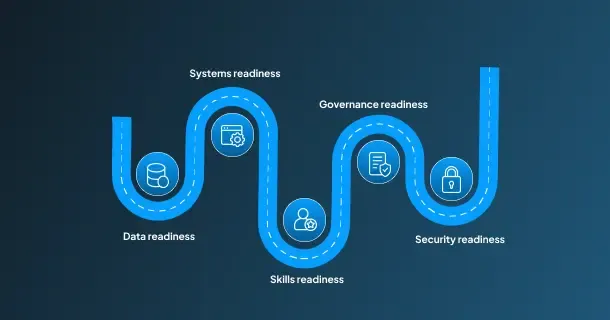
Phase 2: Use-Case Prioritization
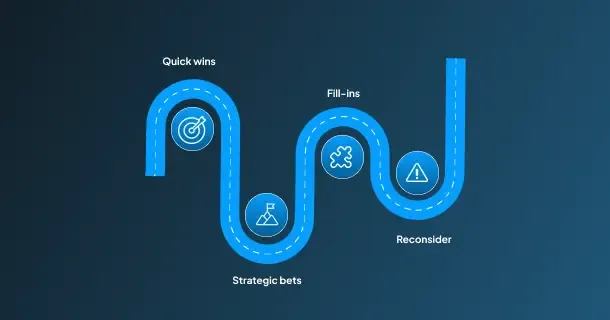
Not every generative AI use case deserves equal investment. Enterprises typically map candidate use cases on an impact-versus-feasibility matrix to separate quick wins from long-term strategic bets.
Category | Description | Example |
Quick wins | High impact, low complexity. Good for building early momentum and stakeholder buy-in | Internal knowledge search, meeting summarization, customer support drafting |
Strategic bets | High impact, high complexity. Requires more data, integration, and governance work | Autonomous agents for claims processing, AI-driven product design |
Fill-ins | Lower impact, low complexity. Useful but not roadmap-defining | Email drafting assistants, internal FAQ bots |
Reconsider | Low impact, high complexity. Deprioritize or shelve | Overly broad "AI for everything" platforms without a clear owner |
The goal is a prioritized backlog, not a single project. Enterprises that start with two or three well-chosen quick wins tend to build the internal credibility needed to fund larger, more strategic AI initiatives later in the roadmap.
Phase 3: Architecture and Data Strategy
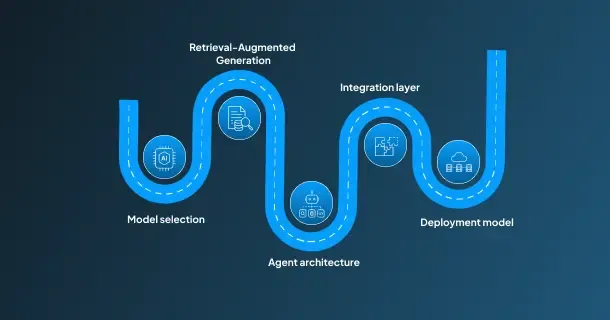
Once use cases are prioritized, the technical architecture decisions begin. This phase typically covers:
Model selection: proprietary models (e.g., via Azure, Open AI, AWS Bedrock, or Google Vertex AI) versus open-source models, depending on cost, control, and data residency needs
Retrieval-Augmented Generation (RAG): connecting LLMs to enterprise knowledge bases so responses are grounded in accurate, current data rather than relying solely on a model's training data
Agent architecture: where applicable, designing multi-step AI agents that can call tools, query systems, and complete workflows rather than just generate text
Integration layer: how generative AI connects to existing systems such as CRMs, ERPs, or platforms like Microsoft Copilot.
Deployment model: cloud, hybrid, or on-premises, based on security and compliance requirements
This is also where enterprises decide how they'll track experiments and model versions over time, often using MLOps tooling such as MLflow to manage reproducibility as models and prompts evolve.
Phase 4: PoC and MVP Development
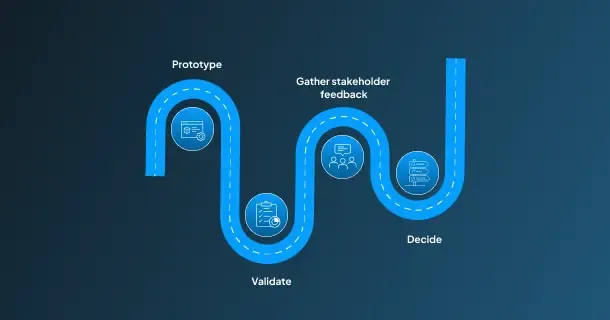
With architecture decisions made, the roadmap moves into building. This phase is intentionally scoped small:
Prototype a working version of the top-priority use case, using real (or realistic) enterprise data
Validate outputs against defined success criteria: accuracy, relevance, latency, and cost per interaction
Gather stakeholder feedback from the actual end users, not just the project sponsors
Decide whether to iterate, pivot, or move to production based on evidence, not enthusiasm
A well-run PoC typically runs for a few weeks, not months. The point isn't a polished product; it's proof that the use case delivers measurable value before enterprise-wide investment is committed.
Phase 5: Production Deployment
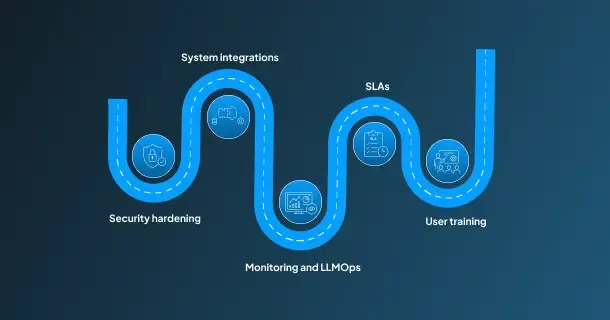
Moving from PoC to production is where many generative AI initiatives stall, because the requirements change significantly. Production deployment involves:
Security hardening: access controls, data encryption, and prompt-injection safeguards
System integrations: connecting the AI solution to live enterprise systems rather than sandboxed data
Monitoring and LLMOps: tracking model performance, latency, cost, and output quality in real time
SLAs: defining uptime, response time, and escalation paths for AI-powered systems the business now depends on
User training: ensuring the teams using the tool understand its capabilities and limitations
This phase turns a validated pilot into a system the enterprise can actually rely on operationally.
Phase 6: Adoption and Change Management
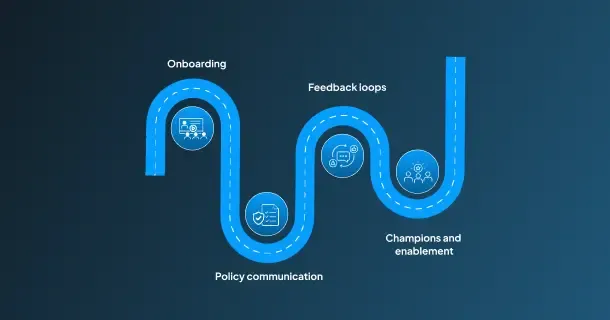
Technology readiness doesn't guarantee organizational adoption. This phase focuses on the human side of the rollout:
Onboarding: structured training so employees know how and when to use the new AI tools
Policy communication: clear guidelines on acceptable use, data handling, and escalation for AI-generated outputs
Feedback loops: channels for users to flag inaccurate or unhelpful outputs, feeding back into model or prompt improvements
Champions and enablement: identifying internal advocates in each department to drive day-to-day adoption
Enterprises that treat adoption as a one-time training session, rather than an ongoing process, tend to see usage drop off within months. Sustained adoption requires the same attention as the technical rollout.
Phase 7: Governance and Continuous Optimization
Generative AI implementation doesn't end at launch. The final, ongoing phase covers:
Evaluation: regularly testing model outputs against accuracy, bias, and safety benchmarks
Guardrails: content filters, escalation rules, and human-in-the-loop checkpoints for high-stakes decisions
Compliance: staying aligned with evolving regulations and internal Responsible AI principles
Model updates: retraining, re-prompting, or swapping models as better options become available
Cost control: monitoring token usage and infrastructure spend as adoption scales across the organization
This phase is what keeps a generative AI program trustworthy and cost-effective as it expands from one use case to many, and from one department to the enterprise as a whole.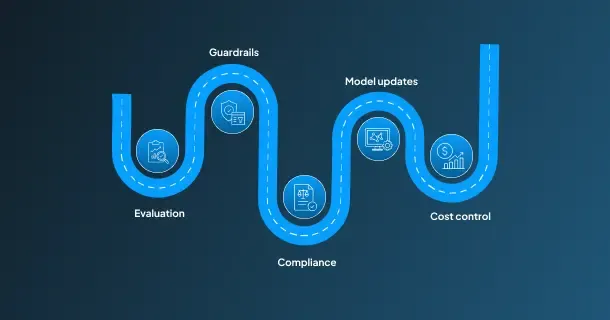
How Centrox AI Builds GenAI Roadmaps
Centrox AI works with enterprise teams to turn this seven-phase framework into a concrete, resourced plan, starting with a readiness assessment and use-case prioritization workshop, then moving through architecture design, PoC development, secure production deployment, and governance frameworks tailored to your industry and compliance requirements.
Rather than a generic strategy deck, the output is a working 30/60/90/180-day roadmap: what gets built first, who owns it, what success looks like, and how it scales.
Book your strategy call today with our experts at Centrox AI, and discover how your tailored idea can be implemented before it's too late.

Muhammad Harris
Muhammad Harris, CTO of Centrox AI, is a visionary leader in AI and ML with 25+ impactful solutions across health, finance, computer vision, and more. Committed to ethical and safe AI, he drives innovation by optimizing technologies for quality.
Every outdated process is a competitive gap. Gen AI is already closing it for others.
Get a Free QuoteYour AI Dream, Our Mission
Partner with Us to Bridge the Gap Between Innovation and Reality.