On-Premise RAG vs Cloud RAG: Which Is Better for Secure AI?
Compare On-Premise RAG vs Cloud RAG for enterprise AI. Explore implementation, security, costs, benefits, and choose the right architecture.
8/3/2026
On-Premise RAG vs Cloud RAG: Which Is Better for Secure AI?
artificial intelligence
9 min read

Every serious AI builder eventually hits the same wall. The engineer wants the fastest path to a working system: spin up a managed vector database, call a hosted LLM API, ship in days.
The CTO wants that too, until legal reminds everyone that patient records, client contracts, or account data cannot legally leave the building. The CEO wants growth without a headline breach. The PM at a growing SMB wants both on a budget that has no room for either mistake. That tension between shipping fast and keeping data private is exactly why on-premises RAG exists as a serious alternative to cloud RAG.
This guide walks through both architectures, their implementation steps, security controls, benefits, limitations, real-world applications, and costs, so you can decide which one actually fits your team.
What is on-premises RAG?
On-premises RAG is a Retrieval Augmentated Generation architecture where the entire pipeline- vector database, embedding models, and LLM inference- runs inside an organization's own data centers or private infrastructure, keeping sensitive data fully within internal network boundaries at all times.
How to Implement On-Premises RAG?
Deploying on-premises RAG requires careful planning across hardware, data pipelines, and model orchestration. Below is a practical six-step framework enterprises can follow to build a secure, self-hosted retrieval system from the ground up.
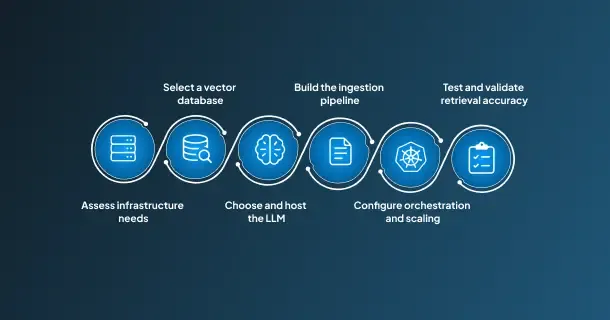
1. Assess Infrastructure Needs
Evaluate GPU capacity, storage, and networking requirements based on projected document volumes, embedding generation workloads, and concurrent query traffic. Proper infrastructure planning ensures the on-premises RAG system delivers consistent performance, low latency, and scalability as enterprise data grows.
2. Select a Vector Database
Deploy an on-premises vector database such as Qdrant or pgvector to securely store and retrieve document embeddings. Self-hosting the vector database provides complete control over indexing, access permissions, and sensitive enterprise data while enabling fast and accurate similarity search.
3. Choose and Host the LLM
Host open-source large language models such as Llama using inference frameworks like Ollama or vLLM on internal GPU servers. Running the model entirely within the organization's infrastructure eliminates dependence on external APIs while strengthening data privacy, regulatory compliance, and response reliability.
4. Build the Ingestion Pipeline
Develop an automated pipeline for document parsing, chunking, metadata extraction, and embedding generation that operates entirely within the private network. A well-designed ingestion workflow ensures new and updated documents are continuously indexed while preserving complete data sovereignty.
5. Configure Orchestration and Scaling
Use Kubernetes to orchestrate containerized retrieval, embedding, and inference services across internal compute clusters. Container orchestration improves resource utilization, simplifies deployment, and provides high availability, load balancing, and horizontal scaling as workloads increase.
6. Test and Validate Retrieval Accuracy
Conduct comprehensive relevance benchmarking, latency testing, and end-to-end validation before production deployment. Evaluating retrieval quality, response accuracy, and system performance ensures the RAG pipeline consistently meets enterprise reliability, efficiency, and service-level requirements.
On-Premise RAG Benefits and Limitations for Enterprise AI Deployment
Once the six-step deployment is live, the real question becomes whether on-premise RAG was worth the investment. This table breaks down the benefits and limitations enterprises should weigh before committing fully.
Aspect | Benefits | Limitations |
Data Control | Complete data sovereignty; sensitive information never leaves internal infrastructure or third-party servers | Requires internal expertise to manage data governance without vendor-provided tooling |
Compliance | Easier alignment with HIPAA, GDPR, SOC 2, and ISO 27001 through direct infrastructure oversight | Compliance audits still demand significant internal documentation and manual effort |
Cost Structure | Predictable long-term costs after infrastructure investment; no recurring per-query cloud fees | High upfront capital expenditure for GPUs, storage, and skilled infrastructure staff |
Performance | Lower latency for internal users since data doesn't traverse external networks | Limited elasticity; scaling requires manual hardware procurement and setup time |
Security | Granular RBAC, custom encryption, and full audit log ownership within private systems | Security posture depends entirely on internal team maturity and vigilance |
Innovation Access | Freedom to customize models and pipelines without vendor lock-in restrictions | Slower access to cutting-edge managed AI services and automatic updates |
How to Ensure Security for On-Premises RAG
Securing an on-premises RAG deployment requires layered controls across data, access, and infrastructure. These four pointers outline the core practices enterprises should implement to protect sensitive knowledge bases.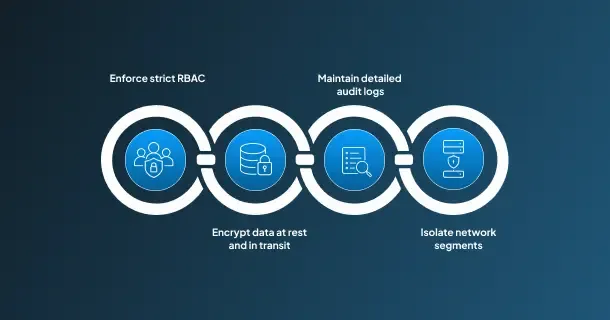
1. Enforce Strict Role-Based Access Control (RBAC)
Restrict vector database and LLM access based on user roles to ensure only authorized personnel can access sensitive enterprise knowledge.
2. Encrypt Data at Rest and in Transit
Secure stored embeddings with AES-256 encryption and protect internal communications using TLS to safeguard data throughout its lifecycle.
3. Maintain Detailed Audit Logs
Log all queries, retrievals, and model interactions to support compliance, monitoring, and security investigations.
4. Isolate Network Segments
Separate the RAG infrastructure using VLANs and firewalls to minimize attack surfaces and prevent lateral movement across networks.
What Is Cloud RAG?
Cloud RAG deploys the retrieval and generation pipeline on managed cloud platforms like Azure, AWS, or Google Cloud, using scalable vector databases and hosted LLM APIs to deliver fast, flexible AI capabilities without maintaining physical infrastructure.
How to Implement Cloud RAG
Implementing cloud RAG involves configuring managed services rather than physical hardware. This six-step approach helps enterprises stand up a scalable, cloud-native retrieval pipeline while maintaining reasonable security controls throughout.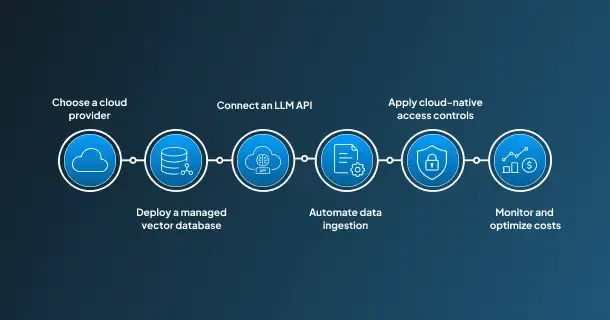
1. Choose a Cloud Provider
Select a cloud platform based on compliance requirements, regional data residency, existing enterprise agreements, and scalability needs.
2. Deploy a Managed Vector Database
Use a managed vector database such as Pinecone or cloud-hosted Qdrant to store embeddings with built-in scalability and high availability.
3. Connect an LLM API
Integrate hosted LLMs through cloud APIs to enable fast inference without managing underlying GPU infrastructure.
4. Automate Data Ingestion
Build serverless pipelines to automatically parse, chunk, embed, and index documents as new content is added.
5. Apply Cloud-Native Access Controls
Configure IAM policies, encryption, and network security groups to ensure only authorized applications and users can access the system.
6. Monitor and Optimize Costs
Continuously monitor inference, storage, and compute usage to optimize resource allocation and control cloud expenses.
Cloud RAG Benefits and Limitations for Enterprise AI
After setting up the six-step cloud pipeline, the tradeoffs become clearer, especially around cost and control. This table outlines the key benefits and limitations enterprises should evaluate before scaling further.
Aspect | Benefits | Limitations |
Scalability | Instantly scales compute and storage to match demand without manual provisioning | Costs can grow unpredictably under high query volumes or heavy usage spikes |
Deployment Speed | Faster time to production using pre-built managed services and APIs | Dependency on provider uptime, roadmap changes, and service-level agreements |
Data Residency | Choice of regional data centers to help meet certain compliance requirements | Data still resides on third-party infrastructure, raising sovereignty concerns |
Cost Structure | Low upfront investment; pay-as-you-go pricing suits variable workloads well | Recurring inference and storage costs can exceed on-premises long-term expenses |
Maintenance | Provider handles patching, updates, and infrastructure reliability automatically | Less customization control over underlying models and infrastructure configuration |
Innovation Access | Immediate access to the latest models, tools, and managed AI features | Vendor lock-in risk when workflows depend heavily on proprietary cloud services |
How to Ensure Security for Cloud RAG Deployments
Securing cloud RAG requires strong identity management, encryption, and continuous monitoring since data and compute resources are shared across provider infrastructure rather than isolated internally, like on-premises setups. These four practices help enterprises close the most common gaps in a shared cloud environment.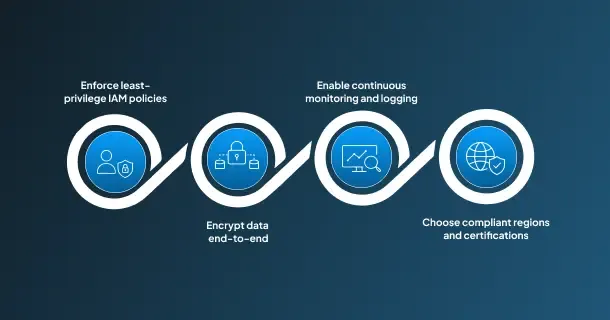
1. Enforce Least-Privilege IAM Policies
Restrict API keys, service accounts, and user roles so each component accesses only the resources required for its function.
2. Encrypt Data End-to-End
Protect data at rest with provider- or customer-managed encryption keys and secure all API communication using TLS.
3. Enable Continuous Monitoring and Logging
Use cloud-native audit logs and anomaly detection to identify suspicious activity and unauthorized access in real time.
4. Choose Compliant Regions and Certifications
Deploy workloads in compliant cloud regions and select providers certified for standards such as SOC 2, ISO 27001, or HIPAA.
On-Premise RAG vs Cloud RAG:
With security controls covered for both architectures, the remaining question is how they truly stack up against each other. This table compares on-premise and cloud RAG across the factors that matter most.
Factor | On-Premise RAG | Cloud RAG |
Data Sovereignty | Full control; data never leaves internal servers | Data hosted on third-party cloud infrastructure |
Compliance Fit | Ideal for HIPAA, GDPR, SOC 2 strict environments | Achievable with certified regions and provider compliance |
Upfront Cost | High (hardware, GPUs, setup) | Low (pay-as-you-go pricing model) |
Scalability | Manual, hardware-dependent scaling | Instant, elastic scaling on demand |
Deployment Time | Slower, complex setup process | Faster, managed-service deployment |
Maintenance | Fully managed internally by IT teams | Handled largely by the cloud provider |
Best Fit For | Finance, healthcare, legal, government | Startups, variable workloads, rapid scaling needs |
On-Premise vs Cloud RAG: Applications and Cost Estimation
Choosing the right architecture depends on what you are building, not just company size. The table below breaks down five common enterprise applications, their ideal RAG architecture, implementation scope, and realistic monthly costs to help you budget accurately.
Application | Recommended Architecture | Scope of Application | Estimated Monthly Cost Range |
Clinical decision support (hospital-scale) | On-premise RAG (HIPAA-sensitive data) | Hospital-wide EHR search, diagnostic support, and clinical documentation retrieval | $8,000 – $25,000 (infrastructure amortized) |
Legal document review (mid-size firm) | Hybrid RAG architecture | Contract analysis, case law search, and compliance document retrieval across practice groups | $3,000 – $10,000 |
Financial risk analysis (enterprise-scale) | On-premise or hybrid RAG | Regulatory filings review, credit risk modeling, and real-time market data retrieval | $10,000 – $30,000 |
Customer support knowledge base | Cloud RAG | Automated ticket resolution, FAQ retrieval, and product documentation search | $500 – $3,000 |
Internal HR/IT helpdesk assistant | Cloud RAG | Policy lookup, onboarding queries, and internal IT troubleshooting support | $300 – $1,500 |
Note: Costs vary significantly based on document volume, query frequency, model size, and chosen infrastructure providers.
Which Has More Future: On-Premise RAG or Cloud RAG?
Today, on-premise RAG gives organizations direct, auditable control over encryption, access, and data residency, while cloud RAG offers strong but shared, provider-managed security. Ahead, on-premise RAG must keep pace with rising GPU and model costs, while cloud RAG must navigate tightening data-residency laws. On-premise RAG is the harder model to sustain long-term, since internal teams alone fund and maintain it.
The fix is a hybrid RAG architecture: keep regulated data on-premises and shift variable workloads to the cloud for scale. Expect falling GPU and inference-hardware costs over the next few years to narrow the price gap, making on-premises and hybrid deployments far more accessible to mid-size enterprises, not just large regulated ones. That hybrid model is the practical future, and Centrox designs and deploys secure on-premises, cloud, and hybrid RAG solutions built for regulated industries.
So, is your current AI infrastructure truly built to protect sensitive data while keeping pace with growth, or is it time to rethink your architecture with an expert partner like Centrox AI?

Muhammad Harris
Muhammad Harris, CTO of Centrox AI, is a visionary leader in AI and ML with 25+ impactful solutions across health, finance, computer vision, and more. Committed to ethical and safe AI, he drives innovation by optimizing technologies for quality.
Every outdated process is a competitive gap. Gen AI is already closing it for others.
Get a Free QuoteYour AI Dream, Our Mission
Partner with Us to Bridge the Gap Between Innovation and Reality.